An AI function your code can call.
Jev takes evidence and a set of questions, then returns probabilities over answers you define.
TypeSafe calls it a System One model: fast, focused judgment for software. It understands natural-language input but does not write replies, SQL, code, or explanations. Your application decides what to do with the answer. [2]
“I was charged twice for the same order. Please fix it.”
Which team?
Billing 94%
Technical 4%
Other 2%
Refund requested?
Probability of yes
0.96
How frustrated?
Calm → upset → angry
1.3 out of 2
Invented outputs, shown to explain the three types. Noul is TypeSafe’s name for a yes/no probability. [3]
The evidence is called state. It might contain a conversation, transaction records, and a policy. Each question sees that same material. “State” means the input to this request; it does not promise persistent agent memory. Current inputs are text-based strings, JSON objects, or arrays—not images, audio, or video. [4]
The exact output contract
Choice returns an option, a distribution across all options, and a derived confidence statistic. Noul returns the probability of yes. Score uses an ordered rubric, returns probabilities across its levels, and a probability-weighted score. [3]
For levels 0, 1, and 2 with probabilities 0.1, 0.5, and 0.4, the expected score is 0×0.1 + 1×0.5 + 2×0.4 = 1.3. A score of 1.3 describes position on a rubric. A yes/no probability of 0.5 describes uncertainty, not medium severity.
Offer an “other” or “insufficient information” choice when appropriate. A constrained model can only choose among the possibilities you provide.
Read once. Ask in parallel.
Two expensive habits can be reduced: repeatedly processing the same evidence, and generating a long answer.
A language model first processes its input (prefill), then normally generates output one token at a time (decoding). The scores available at the first output position can already support a decision. OpenJev reads those scores and stops. [7]
Branches share evidence, not each other’s questions or answers. Values are illustrative. Jev’s exact internal graph is undisclosed. [1]
One document, how many questions?
20 × 10,000 versus 1 × 10,000 state tokens.
An accounting illustration, not a latency or FLOP benchmark. Question processing and attention to the state still cost work. Cache hits are not guaranteed. [5][8]
What the architecture investigation found—and did not prove
Archer Hume probed Jev’s API and reconstructed a plausible architecture. Experiments supported isolation between questions, sensitivity to option order, and interaction among alternatives within a question. These observations constrain possible designs; they do not uniquely identify an attention mask or model family. [1]
The article proposes shared-prefix computation, a causal transformer, and direct readouts. It considers both fixed option-slot scoring and a pointer-like scorer. Sparse mixture-of-experts is the least certain hypothesis. No published weights or full training recipe establish these details. Nothing in the observed behavior requires diffusion. [1]
A mixture-of-experts model stores multiple expert networks and activates only some for each token. That is a possible efficiency mechanism, not an identified Jev component.
Why “causal” does not mean reading input one token at a time
During prefill, every input token is already known. Within a transformer layer, many positions can be processed together while an attention mask prevents a position from seeing forbidden later input. Layers still depend on previous layers. Autoregressive generation adds a different dependency: the next output token does not exist until the previous one is selected.
A KV cache stores attention keys and values from processed tokens. Prefix reuse preserves this intermediate work across requests with common text. It does not remove the cost of reading that context from a new question. SGLang’s RadixAttention is a published approach to automatically reusing shared KV-cache prefixes. [20]
“Parallel” also does not mean one GPU per question or unlimited throughput. It means the branches can be scheduled without waiting for each other’s answers.
Question independence is not probability independence
The API’s contract says each question is evaluated against the shared state. Another answer is not automatically hidden context. If a later question needs newly fetched data or an earlier decision to define its options, make a second request. [3]
Two judgments can nevertheless be correlated. “Is the customer angry?” and “Is the language hostile?” might depend on the same words. Multiplying their probabilities assumes statistical independence, which the serving architecture does not establish.
A working implementation you can inspect.
OpenJev turns an open language model’s next-token scores into a Jev-compatible decision API.
The repository uses Qwen3.6-35B-A3B with SGLang, deployed by default on a B200 GPU. Its jev-latest name is a compatibility alias: requests run on the configured open model, not TypeSafe’s Jev. [5]
- 01Compile the request
Render the shared state and independent question suffixes using the model’s chat template. Disable thinking. [6]
- 02Give every option a one-token label
Use verified labels such as A, B, and C, preserving the original option names for the response. [6]
- 03Warm the prefix, then submit branches
Complete the shared-prefix call first. Submit question calls concurrently, subject to capacity limits. [8]
- 04
OpenJev makes N + 1 one-token calls for N questions, including cache warmup. It has no continuing answer generation, but the backend does produce one sampled token per call. [5]
The code-level path, labels, and limits
prompts.py builds a common prefix and one suffix per question. Choice descriptions determine semantic meaning; keys are hidden unless a null description makes the key the fallback. Labels must encode as exactly one distinct token. This avoids comparing only the first token of a multi-token label such as a number. The compiler validates its set of 64 labels at startup. [6]
service.py awaits cache warmup before creating concurrent branch tasks. It validates context and total submitted-token budgets before GPU work and cancels sibling tasks on failure. [8]
backend.py requests max_new_tokens=1, selected-label log probabilities, and no prompt-logprob recomputation. Its parser checks that one output position was returned. [7]
Default limits include 64 questions, 2–64 options per Choice or Score, and 32,768 tokens per branch including output. Caching is opportunistic, not a pinned per-request session; hybrid recurrent state and memory pressure can affect hits. [5]
Why API compatibility does not mean model equivalence
Compatibility can reproduce field names and output types while leaving weights, prompts, calibration, limits, and serving behavior different. OpenJev’s implementation does not supply TypeSafe’s RLCD training recipe. A functioning replica demonstrates feasibility of the interface, not equivalent decision quality.
The repository’s controlled payload comparisons still involve different internal models and prompts. Any quality gap is a comparison of services, not a clean experiment isolating a single training technique. [11]
A number is not yet a trustworthy probability.
“90% confident,” a 0.90 token score, and a calibrated 90% prediction are three different things.
“I’m 90% sure.”
A sentence the model generated.
Label A: 0.90
A numerical preference over allowed labels.
About 90 in 100
The observed success rate across similar predictions.
Calibration asks whether predicted probabilities match outcome frequencies across groups. Neural networks can be confidently wrong; direct numerical output alone does not fix that. [16]
100 predictions, each saying “80%.”
A well-calibrated group would have about 80 correct answers.
80 predicted out of 100. 80 actually correct.
Illustrative population, not measured Jev data.
TypeSafe describes Reinforcement Learning for Calibrated Decisions (RLCD) as post-training for decisions and honest uncertainty. Its public explanation gives an objective, not a complete reproducible algorithm. Calibration describes groups of predictions; it cannot guarantee any one answer. [14]
Normalization: a distribution can sum to 1 and still be misleading
Suppose a model assigns next-token probability 0.12 to A, 0.06 to B, 0.02 to C, and 0.80 to everything else. Keeping only A/B/C and renormalizing yields 0.60, 0.30, and 0.10. These numbers now describe relative preference within the allowed set.
| Label | Raw probability | Returned share |
|---|---|---|
| A | 0.12 | 0.60 |
| B | 0.06 | 0.30 |
| C | 0.02 | 0.10 |
| Other tokens | 0.80 | Excluded |
OpenJev applies stable softmax to the selected label log probabilities. Normalization does not establish that the chosen answer is correct at the stated frequency. That requires an outcome-based evaluation. [9]
Probability versus the API’s separate “confidence” field
TypeSafe says confidence is a statistic derived from the returned distribution. A peaked distribution receives higher confidence; a spread-out one receives lower confidence. Noul has no separate confidence field. [15]
The public TypeSafe LLM adapter computes Choice confidence as (p_max − 1/K) / (1 − 1/K) for K > 1. Three options with a maximum probability of 0.8 give confidence 0.7. This is verified adapter behavior, not proof of the proprietary endpoint’s exact formula. Its Score calculation uses distances from the modal level. [17]
OpenJev instead uses 1 − entropy(p) / log(K). Both are concentration summaries; neither is a new estimate trained against correctness. Do not move confidence thresholds between implementations without validation. [9]
How to evaluate uncertainty in practice
Measure accuracy alongside probability quality. A reliability plot compares predicted probabilities with observed outcomes in bins. Expected calibration error (ECE) averages bin gaps; the result depends on bin definitions and sample size. Brier score and log loss also reflect predictive skill, so they are not pure calibration measures. [10]
Post-hoc temperature scaling is a published calibration technique. It adjusts score concentration; a positive global temperature does not change which score is largest. It cannot repair every wrong decision. [16]
For a real workflow, use held-out examples, inspect high-confidence mistakes, and recheck after the task distribution changes. Choose action thresholds by measured error costs and performance, not by how reassuring “0.95” looks. [15]
Same interface. Different results.
The repository reports better performance for Jev than its OpenJev baseline on two different tasks.
Accuracy on 1,000 questions
Higher is better24.1 percentage-point difference. Zero-shot API evaluation on a reused 1,000-question subset; not full-test leaderboard scores.
Published repository results, not experiments rerun for this website. [10][11]
Copying the inference pattern did not close the quality gap.
On the matched MMLU-Pro sample, Jev answered 829 of 1,000 questions correctly; OpenJev answered 588. The result supports a service-level difference. It does not identify its cause. [11]
Complete BoolQ results and methodology
| Metric | Jev | OpenJev |
|---|---|---|
| Accuracy ↑ | 91.56% | 89.45% |
| Brier score ↓ | 0.0640 | 0.0812 |
| Log loss ↓ | 0.2257 | 0.2926 |
| Mean selected-answer probability | 89.69% | 93.19% |
| Selected-answer ECE ↓ | 2.51% | 4.05% |
| P(yes) ECE ↓ | 3.53% | 4.64% |
All 3,270 labeled development examples were evaluated with the passage as state and a yes/no question. No temperature fitting or other recalibration was applied. ECE used ten equal-width bins; the report includes passage-clustered bootstrap intervals. Models can have different internal prompts despite identical external payloads. [10]
This establishes results on passage-grounded comprehension, not production-domain calibration or unrestricted factual truth. Training overlap with the public benchmark is unknown.
MMLU-Pro protocol, uncertainty, and a second open-model baseline
Jev’s accuracy was 82.9% (95% Wilson interval 80.4–85.1%); updated OpenJev’s was 58.8% (55.7–61.8%). The paired difference was 24.1 points, with a bootstrap interval of 21.0–27.2 points. Both were correct on 554 items, only Jev on 275, only OpenJev on 34, and neither on 137. [11]
The prompt cleanup reused an inspected subset, so this is not an untouched holdout. It is also not the usual full-test, few-shot chain-of-thought evaluation.
A separate hosted Qwen3.8-27B run scored 60.0% on those same 1,000 questions with reasoning disabled and one output token. It used a different prompt wrapper and serving backend; truncated top-20 log probabilities were used for answer selection, not calibration metrics. [12]
Reasoning buys accuracy—but costs time.
A separate OpenJev research experiment allowed Qwen progressively larger reasoning budgets on 128 new questions. The longest budget improved accuracy and substantially increased latency. [13]
| Reasoning cap | Accuracy | Median internal latency |
|---|---|---|
| 0 tokens | 53.9% | 0.11 s |
| 64 tokens | 51.6% | 0.61 s |
| 256 tokens | 53.1% | 1.89 s |
| 1,024 tokens | 68.8% | 7.25 s |
Same 128 questions across budgets; different sample and prompt from the 1,000-question comparison. Latency excludes external networking, startup, and client-side queuing. [13]
Why these reasoning results are exploratory
Positive budgets enabled native thinking. The harness stopped at the thinking-end token or cap, closed the reasoning block, and scored one final answer token. Only 14 of 128 traces finished naturally at the 1,024-token cap; none did at the smaller positive caps. Runs used concurrency 16. [13]
One sampled trace per question and budget does not capture repeat-run variability. These results do not imply that more reasoning always helps, or establish Jev’s internal computation. A generated wrong reasoning trace can also distort subsequent confidence.
The repository explored five prompt variants on another 256-question sample. Improvements were modest and exploratory; its research notes also identify an untested KV-cache precision control. The cause of the remaining gap is unresolved. [18]
Give each part of the system a clear job.
A fast decision model can complement a reasoning agent. It does not need to replace one.
The following is an engineering proposal, not a benchmarked Jev integration. Imagine an analytics assistant classifying requests, detecting missing information, and choosing a route before a generative model writes SQL.
Judge
Classify intent. Flag ambiguity. Score relevance. Select among known routes.
Create
Write SQL. Investigate failures. Explain results. Work through complex dependencies.
Control
Enforce permissions. Validate schemas. Execute queries. Apply business policy.
Verify
Measure errors, calibration, latency, and when escalation actually helps.
A concrete agent workflow and its evaluation plan
Supply a user request, relevant schema, and available capabilities as state. Ask independent questions together: “Which capability is required?”, “Is a time range missing?”, and “Does this request ask to modify data?” Combine the results with deterministic checks. Fetch additional evidence before a second decision stage if it is genuinely needed.
For each judgment, build a labeled held-out set. Compare a deterministic baseline, a one-token open-model baseline, Jev, and a reasoning-model fallback. Measure task accuracy, reliability curves, p50/p95 end-to-end latency, cost per successful workflow, and accepted-case error rate at each threshold. Reorder choices to check stability. Keep permissions outside the model.
This is our proposed validation plan. TypeSafe’s documented pattern of focused judgments composed in code motivates the workflow, but does not validate its performance on your data. [2]
The useful idea survives the caveats.
Separate the interface, the inference machinery, and the quality of the trained model.
Direct decision APIs are practical.
OpenJev provides inspectable code for concurrent questions, shared-prefix reuse, first-position scoring, and typed responses. [6][7][8]
Two claims to read carefully
“Hallucination-free” does not mean error-free. A schema can force the output to be “approve,” “reject,” or “review.” The model can still select the wrong one. TypeSafe’s launch discussion ties its zero-type-error claim to schema guarantees. [19]
A large speedup is workload-dependent. TypeSafe acknowledges that its comparisons depend on prompt shape, reasoning settings, and requiring probability-filled structured responses from baseline models. An apples-to-apples evaluation should match output requirements, quality, hardware, and workload. [19]
Evidence ledger: which source supports which conclusion?
| Claim | Evidence level | Basis |
|---|---|---|
| Jev returns typed decisions and probabilities | Vendor documentation | 2, 3 |
| OpenJev implements first-token label scoring | Inspected code | 6–9 |
| Question isolation and option interactions in Jev | Black-box experiments | 1 |
| Jev uses a specific MoE or output head | Unconfirmed hypothesis | 1 |
| Jev outperforms this OpenJev baseline | Repository-reported evaluations | 10–12 |
| RLCD caused the whole performance gap | Not established | No isolating ablation |
| Confidence fields equal correctness likelihood | Not established | 9, 15, 17 |
| Agent routing is a promising use | Engineering inference | Requires workflow-specific testing |
How this hub actually runs Jev today.
Facts from Haiyuan’s live agent harness as of 20 September 2026 — not a vendor roadmap. Distinct from the OpenJev replica study above. Production path is OpenRouter TypeSafe, not the open replica.
Decide cheap, execute expensive
TypeSafe Jev via OpenRouter typesafe/jev-1.13 (POST https://openrouter.ai/api/v1/systemone) returns Choice / Score / Noul only — no text gen. Grok Bot + Mac CLIs still do the work.
typesafe/jev-1.13 System One — live seat, not waitlist-only. Pin 1.13 (not jev-latest) for thresholds.
jev-route/home/box/bin/jev-route '<state>' [gate] · skill jev-usage-router
confidence_floor: 0.55 — honor Choice when ≥ floor; else CoS fallback. Confidence ≠ permission.
Always multi-question · gates
One OpenRouter call per gate packs Choice + Score + Noul (speculative fan-out). Code ignores unused answers. Still no text generation from Jev.
| Gate | When | Primary Choice |
|---|---|---|
intake (default) | Ambiguous route / fan-out | route: inline | field_brief | coding_em | escalate |
pre_browser | Before computerUse / browser | browser_action: proceed | skip | escalate |
pre_retry | Before expensive Mac CLI retry | retry_decision: retry | abort | escalate |
pre_research | Before Field Brief / full scout | research_depth: skip | light_web | full_scout | escalate |
Smoke (2026-09-20)
| Gate | Choice | Conf | Honor |
|---|---|---|---|
| intake research | field_brief | ~0.54 | false → cos |
| intake coding | coding_em | ~0.90 | true |
| pre_browser | proceed | ~0.68 | true |
| pre_retry | retry | ~0.87 | true |
| pre_research | full_scout | ~0.17 | false → cos |
Same-day Manage Stories demo: field_brief @ 0.95 (honor) but pack-only — hub Stories HTML not published.
Rooms
Default asks → Manage (CoS). Visible research handoffs → Field Brief room. Coding EM for PR loops. Playbook: harness #jev-session.
state. Jev never authorizes merge / pay / send — confidence gates routing only. Lab backlog only (not installed): jev-browser, jev-guard. Keep mode: active unless the router is broken.Operator bits: config /home/box/agent-data/jev/router.json; logs /home/box/agent-data/jev/logs/; vault card Agents/jev.md; Decision lock Maps/Decisions/2026-09-20-jev-decision-layer.md. Full operating detail: Harness playbook §13.
How CUA, WebMCP, and Jev fit together.
One loop: Jev judges → prefer a WebMCP tool when the page declares one → otherwise fall back to CUA driving Chrome pixels/DOM. Jev never authorizes pay, send, or merge.
CUA
Drives Chrome (pixels / DOM) when selected as the executor. Slow when hunting UI; needed when no tool exists.
WebMCP
The page declares callable tools. The agent invokes them directly — usually faster than poking the DOM.
Jev
Fast Choice over closed options (~ms). Picks the route/tool. Does not drive Chrome or write prose.
User goal → Jev Choice → if WebMCP tool available use it · else CUA DOM
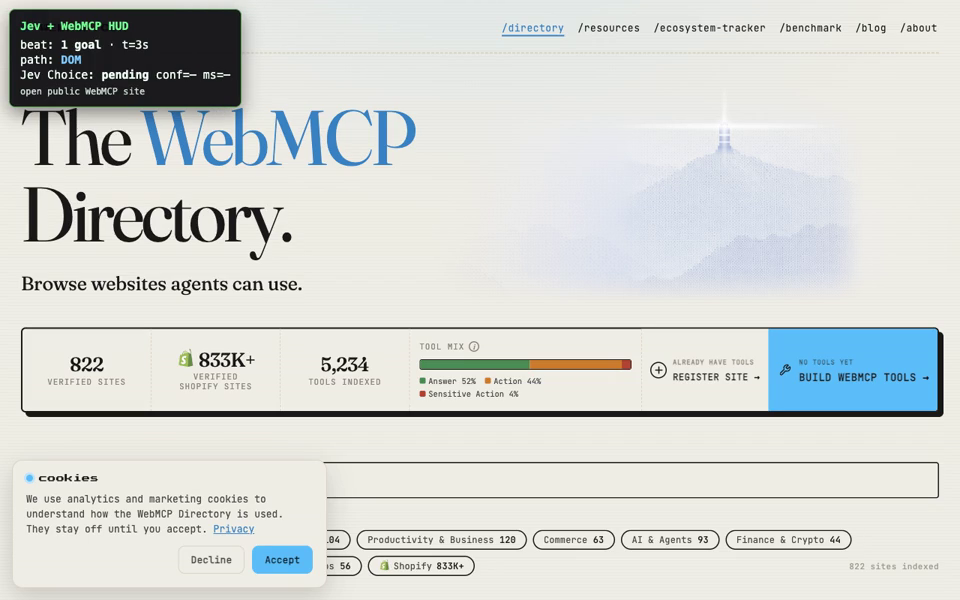
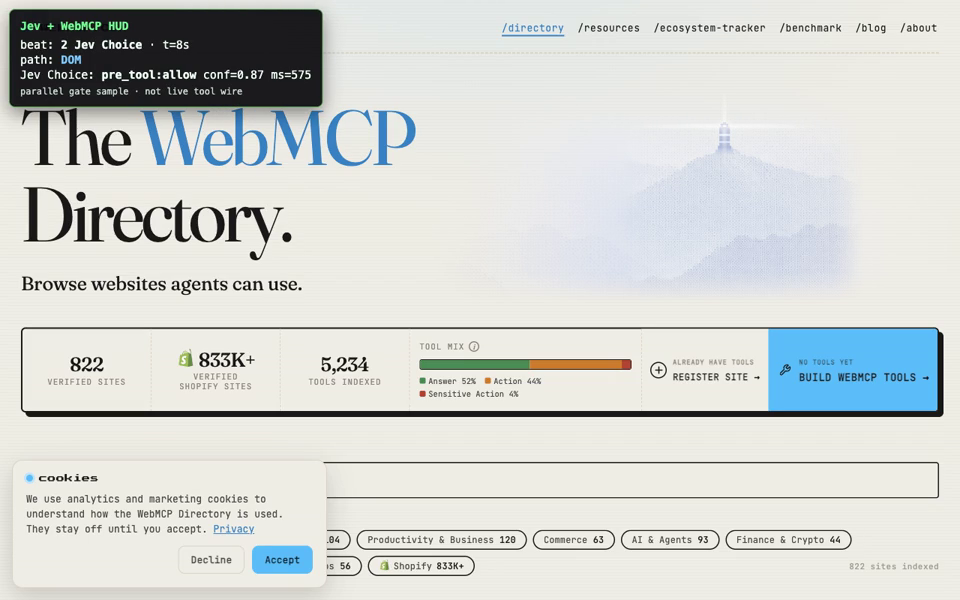
HUD-annotated Chrome clip (Step 2)
~37s headed Mac Chrome on webmcp.com / store.nekuda.ai with an on-page HUD showing beat · path (WebMCP|DOM) · Jev Choice · conf · ms. No desktop/chat leak (page frames only).
- Beat 1 — Goal: open a public WebMCP site.
- Beat 2 — Jev Choice (on HUD): parallel System One
pre_toolsample burned into the overlay — allow · conf 0.87 · wall 575 ms · path labeled DOM (gate sample, not a live WebMCP-vs-DOM router wire). - Beat 3 — Chrome executes: scripted CDP navigates / clicks while the HUD stays visible.
Clip provenance: Headed Mac Chrome; HUD injected via CDP Runtime.evaluate; frames from CDP Page.captureScreenshot assembled to mp4. CUA was not run. No WebMCP tool executed. OS screencapture/ffmpeg avfoundation Capture screen returned black (~144 KB identical frames) at record time — TCC/Screen Recording — so this Step 2 ship uses CDP page frames, not OS desktop pixels.
mp4 · kf01 · kf02 · kf03 · Jev Choice JSON

What this HUD clip proves / does not prove
| Proves | Does not prove |
|---|---|
| On-screen Choice / latency / path HUD over real headed Mac Chrome page content (no desktop/chat leak). | OS desktop screencapture of the Chrome window (that path was black/TCC at record time). |
Parallel System One gate sample visible in-frame: 575 ms · conf 0.87 · pre_tool:allow. |
A live closed loop where Jev’s Choice drives Chrome mid-frame (HUD is labeled parallel / not live wire). |
| Teaching beats for goal → Choice → execute on a public WebMCP site. | Native WebMCP tool execute; pay / send / merge (never authorized). |
Prior #88 OS-cropped clip (no HUD)
Cropped OS recording of headed Chrome (~28s) from #88 — reading-guide beats only; no on-screen Choice HUD.

Recipe table + mock / WindTunnel notes (secondary)
Recipe (keep layers separate)
| Layer | Job | Ours |
|---|---|---|
| WebMCP | Page declares tools | Public sites; Chrome testing flag when enabled |
| Jev | Choice over closed IDs | OpenRouter typesafe/jev-1.13 |
| Executor | Run tool / click | Scripted CDP drove headed Chrome |
Mock complete:true and WindTunnel board numbers remain secondary citations. WindTunnel: WebMCP path 49/49 · 96.5 vs DOM 25/49 · 67.3 on webmcp.com/benchmark (external, not our re-run).
Follow the evidence.
Every source below was inspected for this study or its preceding research. Code and repository reports are linked to a fixed revision; vendor documentation and the article can change. Study access date: 19 September 2026. Fleet appendix: 20 September 2026.
This is an independent synthesis, not a TypeSafe publication. We inspected documentation, code, and published results; we did not rerun model evaluations. Illustrations are explicitly labeled. No private conversations or internal company data are included.
- Jev’s Architecture Unmasked ↗
Black-box experiments and a proposed architecture. Distinguishes observations from inference; does not disclose Jev’s internals.
- System One: what Jev does ↗
Defines typed decisions, model scope, text-only input, and use inside a larger workflow.
- Primitives: Choice, Noul, and Score ↗
Output types, independent questions, focused judgments, and when a second request is necessary.
- State: supplying the evidence ↗
Supported state formats, shared evidence, and current modality limitations.
- OpenJev repository and inference guide ↗
Model and serving configuration, one-token calls, cache caveats, defaults, and compatibility behavior.
- Prompt compiler ↗
Native chat template, disabled thinking, independent suffixes, option descriptions, and single-token label validation.
- SGLang backend client ↗
Requests exactly one output position and extracts selected-label log probabilities; validates backend responses.
- Evaluation orchestration ↗
Prefix-warmup barrier, concurrent branches, input admission, timing, and cancellation behavior.
- Probability and confidence calculations ↗
Stable softmax, expected scores, argmax choices, and normalized-entropy confidence.
- BoolQ: OpenJev versus Jev ↗
3,270 examples; accuracy, Brier score, log loss, calibration error, high-confidence errors, and methodological limitations.
- MMLU-Pro: matched comparison ↗
1,000-question zero-shot comparison: Jev 82.9%, OpenJev 58.8%, paired differences, and reused-subset caveat.
- Qwen3.8-27B: another one-token baseline ↗
Hosted open-model comparison on the same sample, with distinct prompts and backend; no calibration claim from truncated logprobs.
- Capped reasoning on MMLU-Pro ↗
128-question reasoning-budget study. Reports accuracy, warm internal latency, truncation, and sampling limitations.
- AI primer: the stated RLCD objective ↗
Describes post-training toward calibrated decisions; not a complete public training recipe.
- Confidence: meaning and use ↗
Explains confidence as a derived statistic and the need for domain-specific thresholds.
- On Calibration of Modern Neural Networks ↗
Primary research on neural-network miscalibration and post-hoc temperature scaling.
- TypeSafe adapter confidence formulas ↗
Choice confidence relative to uniform probability and a separate modal-distance Score formula. Not verification of the proprietary server formula.
- OpenJev prompt research and unresolved controls ↗
Prompt variants, limited improvements, untested precision controls, and possible future training directions.
- Introducing System One Models & Jev ↗
Vendor claims about direct outputs, speed, RLCD, and type safety, including the company’s benchmark qualifications.
- SGLang: Efficient Execution of Structured Language Model Programs ↗
RadixAttention and automatic KV-cache reuse for structured language-model workloads; prior art, not evidence of Jev’s implementation.
- OpenRouter · Jev 1.13 ↗
Live seat this fleet calls: structured decisions via System One; pin 1.13 for thresholds.
- OpenRouter · TypeSafe SDK / System One ↗
Point SDK at OpenRouter API →
/v1/systemone; map model totypesafe/jev-1.13. - Confidence-gated routing ↗
Official pattern: answer = what; confidence = whether to act; risk-scaled thresholds.
- Speculative fan-out ↗
Multi-question one call, parallel eval — grounds always-multi-q
jev-route. - Grok Bot overview ↗
Persistent cloud computer and multi-Bot coordination — execution layer; Jev does not replace it.
- Jev confidence in production ↗
High confidence ≠ correctness; action-risk thresholds; example floor band includes 0.55.
- trycua/cua · jev-use example ↗
CUA Driver + TypeSafe Jev bounded browser loop; credential-free mock verify.
- WindTunnel WebMCP benchmark ↗
v1.2 board: Jev+Mercury WebMCP 49/49 vs DOM-ultrafast 25/49; cited as external reference, not re-run here.